| Irish Clans and Chiefs Back to Homepage |
Report on the Pedigree
of Terence Maguire,
Styled The Maguire, Prince of Fermanagh
The undersigned first drew the attention of
Chief Herald O Donoghue to the problems surrounding Terence Maguire's
claim to be a Chief in June 1999, and presented to him a copy of the
following report in September 1999. Two years later, in July 2001, the
Chief Herald states the position to be as follows: 'I
wish to advise that no progress can be made in relation to the courtesy
recognition of Mr Terence Maguire as the Maguire of Fermanagh pending
receipt of advice from the Office of the Attorney General in relation
to legal issues raised by the solicitor acting for Mr Maguire.' In July
2003 the Office of the Chief Herald announced its abandonment of the
procedure of courtesy recognition of chiefs, leaving the issue of
questioned claimants unresolved, with the exception of the Mac Carthy Mór case. The claimant to
the title
of Maguire of Fermanagh passed away in February 2005, and his death
notice in the Irish Times of 22 February made no mention of chiefly
status.
Over a period of seven years
starting in 1999, the writer has
endeavoured under the Freedom of Information Act to secure copies of
records relating to the Maguire of Fermanagh chiefship. After
protracted applications, and correspondence and appeals to the
Information Commissioner, in May 2006 a release of some documents was
secured from the National Library of Ireland. Unfortunately, it was
found that there was little of value in the release, much of the most
important documentation being withheld on the grounds that the
information therein was 'obtained in confidence'. Records to which
access is denied include correspondence with the late Mr Maguire's
solicitors and a 2001 report on his claim to chiefship commissioned
from professional genealogist Máire Mac Conghail by Chief Herald
Brendan O Donoghue. Also withheld is correspondence of Chief Herald
Donal Begley predating April 1998, when the FOI Act came into force,
which would throw at least some light on the controversial decision to
recognise Mr Maguire as a chief in 1990. The refusal of access to
records by the National Library is being appealed, and many more months
if not several years may elapse before a final decision is made by the
Information Commissioner. FOI appeals now involve the payment of
hundreds of Euros in fees, and although the process has therefore
become a rather expensive game of poker, the writer will not be obliged
to leave the table just yet. In the meantime, the following report is
being left unamended as an historical
document, and the writer's Twilight of
the Chiefs: The Mac Carthy Mór Hoax also contains an account
of the Maguire case. S Murphy, 30 June 2006.
Background
In the wake of the recent derecognition by the Irish Genealogical
Office of Terence Francis MacCarthy as The MacCarthy Mór,
attention has now turned to other Chiefs. In particular, questions have
been raised about the validity of the recognition of Terence Maguire as
The Maguire, and doubts expressed about his claim to the additional
title of Prince of Fermanagh. Mr Maguire is in fact the great-uncle of
Mr MacCarthy, and the latter was apparently closely involved in
carrying out the research for the Maguire pedigree. There are striking
parallels between the Maguire and MacCarthy cases, in particular the
assertion of a line of descent which on close examination does not
appear to be satisfactorily documented. The Irish Genealogical Office
recognised Terence Maguire as The Maguire in 1990, and as in the
MacCarthy case, it will be shown that the office does not appear to
have performed adequate checks before validating the claim.
The present writer has communicated his concerns to Mr Maguire, who while listening courteously, declined to discuss his pedigree in detail, or to provide additional documentation or clarification of uncertain points. Furthermore, Mr Maguire has refused to grant permission for access to the Genealogical Office file containing the documentation supporting his application for recognition, and this of course has greatly hampered investigation of the case. The present writer has acceded to Chief Herald O Donoghue's request to delay a formal application for access to the Maguire file until later this year, and indeed there is a pending decision by the Freedom of Information Commissioner in relation to an application for access to the MacCarthy Mór file. The writer also agreed to delay publication of the present report, but regards himself as now released from this commitment as a result of two developments. The first is the publication of Peter Berresford Ellis's Erin's Blood Royal, in which the claims of Messrs MacCarthy and Maguire are asserted with renewed vigour. The second is a widely advertised conference on 11 September 1999 organised by the Dun Laoghaire Genealogical Society, which is billed to be officially opened by 'His Excellency, The Maguire, Prince of Fermanagh'.
Pedigree of Maguire
The main published account of the pedigree of the currently recognised
Maguire of Fermanagh is an article by Terence MacCarthy published in Familia,
the journal of the Ulster Historical Foundation, which article has
recently been republished in a collection of essays. Mr MacCarthy
declares that the Belfast family to which Terence Maguire belongs bases
its claim to the Maguire Chiefship on its descent from Brian Maguire,
First Baron of Enniskillen. 'Unfortunately', adds Mr MacCarthy, 'this
claim cannot be verified from historical records because of a lack of
source material', and he advances instead as evidence 'the tradition of
the family'. According to this supposed family tradition, the Belfast
Maguires were descended from the fourth son of the First Baron of
Enniskillen, Thomas, but at least four of the intervening generations
are undocumented. The following is a summary of the Belfast Maguire
pedigree, showing both the undocumented elements and the relationship
between Mr Maguire and Mr MacCarthy.
Pedigree of the Current Maguire of Fermanagh
Bryan Maguire, 1st Baron of
Enniskillen
d 1633
|
Thomas Maguire
|
Conor Maguire
|
Donal Maguire
|
Philip Maguire
|
Daniel Maguire
d Battle of Antrim 1798
|
William Maguire
|
Robert Maguire
Chandler
|
Robert Maguire
b c1854, chandler
m Rose Anne Morrison 27 November 1875, Belfast
|
James Maguire
Labourer
m Bridget McKeown
_____________|_____________
|
| |
| |
Sources: Register of Chiefs, GO MS 627, page 50;Terence Francis MacCarthy, 'A Brief Genealogical Account of the Maguires, Princes of Fermanagh and Barons of Enniskillen', Familia, 2, No. 6, 1990, pages 3-19, and reprinted in An Irish Miscellany: Essays Heraldic, Historical and Genealogical, Gryfons Publishers, Little Rock, Arkansas, 1998; selected birth and marriage registrations, General Register Office, Dublin, and General Register Office, Belfast; italicised entries constitute undocumented relationships.
An undocumented pedigree is not a sufficient basis on which to grant recognition of a Chiefship, and the Genealogical Office should have rejected the Maguire claim on this point alone. It would appear that the above pedigree is based on sentimental family imaginings at best, brazen fabrication at worst, as evidence has been found that the son and grandson of Thomas Maguire were not named Conor and Donal, but Thomas and Hugh. This information was noted firstly in an article by the Earl of Belmore, and is based on information obtained from the old Office of Arms, now of course succeeded by the Genealogical Office. The details of the relevant portion of this pedigree can be summarised as follows:
Pedigree of Maguires of Enniskillen
Brian Maguire, 1st Baron of
Enniskillen
d 1633
_____________|_____________
|
| | | |
| |
Source: The Earl of Belmore,
'Gleanings for Former Fermanagh Articles',
Ulster Journal of Archaeology, Series 2, Vol 3, 1897, page
183.
Thus it would appear that that the Genealogical Office, then administered by Chief Herald Begley, did not bother to review relevant publications, or even to check its own records before accepting the Belfast Maguire Pedigree in 1990. The present writer of course sought corroboration of the Earl of Belmore's information by setting out to check the main Maguire pedigrees among the Genealogical Office records. Unfortunately, he encountered once again that problem which has bedevilled his work in the Genealogical Office for so many years, namely, refusal of prompt and ready access to original manuscripts. On presenting completed dockets for certain Genealogical Office manuscripts, in the way prescribed for accessing National Library of Ireland manuscripts, he was referred instead to poor quality microfilm copies, which in the first place are semi-legible or illegible in places, and in the second place are not reallly suitable for fully comprehending complicated pedigrees often spread over two or more large ledger pages.. An appeal to current Chief Herald O Donoghue met with the usual unsympathetic reception and a further referral to Deputy Chief Herald Gillespie, who eventually produced the required manuscripts, neither of which was found to contain any relevant information (Registered Pedigrees, MSS 171, 173). While on this occasion the writer was not put to the same degree of trouble as he was in the course of his MacCarthy research, nonetheless he feels entitled to protest at these continuing obstacles to scholarly research, which he is satisfied have been created to obstruct discovery of genealogical truth and official maladministration, rather than to protect 'fragile' records.
Fortunately, the late Edward MacLysaght came to the writer's rescue in this instance by providing another form of corroborating evidence, in the shape of a pedigree this more careful Chief Herald had placed in a Genealogical Office file on the Maguire Chiefship, which file is unmicrofilmed, no longer current and thankfully now accessible for examination. The pedigree in question, of the Maguires of Enniskillen, records the above mentioned Thomas Maguire as having a son Thomas Oge, who in turn had a son Hugh, who died without a male heir (Genealogical Office MS 819/3, attachment with letter of 10 October 1945 from J E McGwire to Edward MacLysaght). It is only fair to point out that another reference has been brought to the writer's attention, indicating that Hugh Maguire son of Thomas did in fact have offspring, but again there is nothing in this to support the claims of Terence Maguire ('Geinealaighe Fearmanach', Analecta Hibernica, 3, 1931, entries 517 and 519, page 100; reference courtesy of Patrick MacAuley of Oak Hill, Virginia).
Elsewhere, Terence MacCarthy has amplified the status of his Maguire relatives by according to his mother Harriet the courtesy title of 'Honourable', and to his grandfather Anthony Maguire the additional title of 'Lord Enniskillen' (Commentary to Samuel Trant MacCarthy Mór, The MacCarthys of Munster, Facsimile Edition, Gryfons Publishers, Little Rock, Arkansas, 1997, page 523). As Peter Kurrild-Klitgaard has pointed out, Anthony Maguire and Harriet Maguire do not appear in any of the standard peerage works, and the only evidence offered for their claimed status is the writings of Terence MacCarthy himself (newsgroup posting, 10 August 1999, archived at http://www.deja.com).
The Arms of Maguire of Belfast
In the Familia article referred to above, Terence MacCarthy
puts forward as additional circumstantial evidence the arms of the
Belfast Maguires, which vary the standard Maguire arms by changing the
field from vert (green) to azure (blue), allegedly indicating possible
descent from Lord Maguire's fourth son. Furthermore, Mr MacCarthy
suggests that the additional feature on the arms of the Belfast
Maguires of three roses argent (silver) is an allusion to the three
Stuart Kings in exile. Given that we have shown that the genealogical
information is spurious, no credit needs to be given to these heraldic
speculations. Again, Chief Herald Begley confirmed the arms in question
to Anthony Maguire, the then head of the family, in 1985. The Chief
Herald's patent, an interesting document which is reproduced in Mr
MacCarthy's article, outlines the pedigree of the Belfast Maguires from
about 1760, giving no source other than 'family tradition', and notes
that the family has 'long used and borne' the illustrated arms being
confirmed. Once more, one is entitled to ask for any evidence of this
long usage of arms to be made available for inspection.
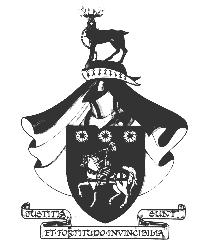
Arms of Maguire of Belfast, as Confirmed by the Genealogical Office
Other Claims to the Maguire Chiefship
The similarities between the Maguire and MacCarthy cases are completed
by the fact that there is also a rival interest in the Maguire
Chiefship, namely, that of the family of Robert Charles Maguire of
Charleston, South Carolina. A summary of Mr Maguire's descent from the
Maguires of Tempo may be seen at the Internet site 'Jim's Irish Family
Surnames', http://www.cris.com/~Maguire/Mdescent.html
(this is a remarkably extensive pedigree of the principal Maguire
branches done in HTML, but it contains some inaccurate or questionable
elements). Robert Charles Maguire has furnished detailed copy documents
to the present writer, which on initial examination at least, indicate
that his is a serious claim deserving further investigation, although
it is not entirely clear if he himself can prove senior descent in the
male line. There may well be another potential claimant to the Maguire
Chiefship in England, as Terence Gray identified Lieutenant Colonel
John Edward McGwire of London as a possible candidate in the 1940s
(Genealogical Office MS 610, page 87), and MacLysaght later
corresponded with the same individual until his death in 1950
(Genealogical Office MS 819/3).
At this stage it should also be very clear that attempts to revive the long dead Gaelic system of Tanistry, whereby Chiefs were appointed by the derbfhine or three-generation group of male descendants of a common ancestor, are simply a cover for genealogical fantasies and fabrications. The localistic and intimate Gaelic society that facilitated a system such as Tanistry is gone forever, and assembling an authentic derbfhine in today's busy and dispersed world would be extremely difficult if not impossible. Primogeniture, or descent in the senior male line from the last inaugurated holder of the Gaelic title, is the only practical criterion on which to base recognition of Chiefs, as MacLysaght realised. Vague references to alleged decisions of kin gatherings, supposed family traditions, or worse still, 'Clan' elections of Chiefs, must not be accepted as substitutes for hard documentary evidence. The decision by Chief Herald Begley to abandon the criterion of primogeniture for Chiefly recognition can now be seen as misguided in the extreme, and it is to be hoped that this action has also been repudiated by the current Chief Herald.
Conclusion
Both in terms of the parties involved and the questionable procedures
employed, the MacCarthy Mór and Maguire cases display
similarities which are too close for comfort, and demonstrate the
absolute nadir to which standards had fallen in the Genealogical Office
in the late 1980s and early 1990s. It has been put about that the
present writer was ejected from consultancy work in the Genealogical
Office in 1993 on account of his 'unsuitability'. The 'unsuitability'
in question lay in adherence to principles and standards in an
environment where such were generally regarded as optional extras. The
present writer could have gone with the flow and published a book
promoting Irish 'Clans' and uncritically listing questionable Chiefs,
all with a foreword by the then Chief Herald, but although it has cost
him dear, he has absolutely no regrets about choosing a different path
(John Grenham, Clans and Families of Ireland, Dublin 1993,
pages 11, 135, 149). Genealogical Office insiders would have been aware
of the problems relating to the pedigrees and arms of certain
recognised Chiefs well before those on the outside, but of course they
were too busy protecting their own narrow interests to take any action.
The State has not been well served by these people, and is paying a
high cost for their inaction, not least in terms of the low regard in
which the Genealogical Office is now held internationally. Once again,
the writer calls for an official investigation into the workings of the
Genealogical Office, followed by a programme of root and branch reform,
the complete integration of the Office into the National Library of
Ireland, and the institution of a proper system of competitive
tendering for genealogical and heraldic consultancy work.
While difficulties persist and he remains excluded from consultancy work, the writer has endeavoured to maintain a form of dialogue with the Genealogical Office concerning the problem of recognition of Chiefs. It may yet be realised that slamming the door on the messenger is no substitute for taking cognizance of his message. The present writer's report of June 1999 identifying the problems relating to Terence MacCarthy's pedigree was followed within a month by withdrawal by the Genealogical Office of recognition of him as MacCarthy Mór. Although the Genealogical Office has failed spectacularly in its stewardship of Chiefly recognition in recent years, there simply is no other agency capable of dealing with what will always be a complex and time-consuming task. The Standing Council of Irish Chiefs and Chieftains allowed itself to be thoroughly gulled by MacCarthy and his supporters, and clearly this body lacks the capacity to distinguish real from fake Chiefs. Yet the Genealogical Office's withdrawal at this point from the work of vetting Chiefs would be a dishonourable retreat, and would leave the field wide open to fantasists and frauds. The standards set by MacLysaght should therefore immediately be reinstated and indeed raised further, the cases of all Chiefs recognised since 1990 should be re-examined by competent persons, and new claims to Chiefships should be investigated promptly but thoroughly. The writer continues to work voluntarily to clean up the Chiefs mess, the total of the unremunerated hours spent on the Maguire case being about 50 and rising, but he cannot indefinitely shoulder this burden without support.
In conclusion, just what is to be done in the particular case of the currently recognised Maguire Chief? Truth may be suppressed for a time, but it has a tendency to break free eventually, when its liberating influence extends even to those who have sought to deny it. We have admitted that we are not unmoved by the clear distress of those whose ancestral fantasies are exploded. Yet consider as well how the practices we have exposed have blighted or blocked the careers of those who would endeavour to maintain some kind of standards in Irish genealogy and heraldry. The present writer must now state publicly what he has been urging privately for some months: the only honourable course of action is for Terence Maguire to renounce his title and voluntarily request the Chief Herald to withdraw recognition. Failing this, the Chief Herald should proceed in the Maguire case as he did in the MacCarthy case, by withdrawing recognition of the title, cancelling confirmation of the arms and declaring that the registered pedigree is 'without genealogical integrity'.
Sean Murphy MA
Centre for Irish Genealogical and Local Studies
9 September, amended 26 December 1999
Ten Years Later: An Addendum to The Maguire of Fermanagh Report
After
ten years of applications and appeals on my part, the National Library
of Ireland, on the recommendation of the Office of the Information
Commissioner, released on 2 March 2009 a significant part but not
the whole of the file records relating to the Maguire of Fermanagh
chiefship. Retained material includes all records pre-dating April
1998, when the FOI act came into effect, and all records and parts of
records relating to the health or personal circumstances of the
claimant, the late Terence Maguire who passed away in 2005.
It
should be remembered that Mr Maguire was recognised by Chief Herald
Donal Begley in 1991 and was a grand-uncle of the hoaxer Terence
MacCarthy 'Mór', exposed in 1999. The records released to me range in
date from 19 July 1999 to 27 November 2001 and are composed of letters
of the claimant Maguire and his solicitors, letters of Chief Herald
Brendan O Donoghue, a memorandum of Deputy Chief Herald Fergus
Gillespie and a report of genealogist Máire Mac Conghail.
The
first point cleared up by the release of documents is to confirm that
MacCarthy was indeed the principal 'researcher' behind the pedigree
presented in support of Terence Maguire's claim to chiefship, and of an
earlier successful application for confirmation of arms submitted on
behalf of his also now deceased brother Anthony Maguire. Quoted
extracts from documents reveal the usual Terentine excuses concerning
allegedly lost records, for example, in August 1981 the then Chief
Herald Gerard Slevin was informed that some certificates were 'missing
for the earlier period before civil registration as they were destroyed
during the last war'. There were also references to a 'longstanding
tradition of the family', a formula which some claimants to Irish
chiefships regard as placing matters beyond argument, but which careful
genealogists tend to regard with scepticism.
It would also
appear that an affidavit of Terence Maguire, dated 3 December 1990,
access to which is still refused, played an important part in his
acceptance as chief by Chief Herald Begley. Another key document cited
is a letter from Begley to Maguire dated 11 January 1991, from which
the following quote has been released: 'I write to state that following
exhaustive scrutiny of all available sources I have acceded to your
petition for recognition as Maguire [of] Fermanagh, Chief of the Name'.
Exhaustive indeed! This letter was copied to Chief Herald O Donoghue by
Maguire's solicitors and appears to be among records missing from the
files in the Office of the Chief Herald (as I have indicated before,
someone appears to have weeded incriminating material from the files
relating to Mac Carthy Mór and some other controversial chiefly
claimants).
Following up on my Mac Carthy Mór report of June
1999, and having acceded to Chief Herald O Donoghue's request to delay
action in order to allow him to deal with the matter, on 9 September
1999 I completed another voluntary report on the Maguire chiefship. I
copied this report to O Donoghue, and although not formally
acknowledged I believe it was read very carefully if not exactly
appreciatively. My report concluded that the pedigree presented by Mr
Maguire did not appear to be 'satisfactorily documented'. In
particular, I pointed to the 'undocumented status' of four alleged
descendants of Bryan Maguire, 1st Baron of Enniskillen who died 1633:
Conor Maguire - Donal Maguire - Philip Maguire - Daniel Maguire, died
Battle of Antrim 1798.
Ms Mac Conghail's report, commissioned by
Chief Herald O Donoghue subsequent to the receipt of my report, was
dated 15 August 2000 and effectively came to the same conclusion as I
had, declaring that 'adequate documentation' had not been submitted to
support Maguire's claimed lineage. Ms Mac Conghail referred to the
absence of evidence in relation to the same four individuals I had
specified, naming them as Conchubhar, Domhnall, Philip and Daniel, but
erroneously writing 'Battle of Aughrim' rather than 'Antrim'.
Mr
O Donoghue had described me in 1999 as the 'self-appointed saviour of
Irish genealogy' on account of my work to expose the Mac Carthy Mór
hoax, and in the context of efforts to portray me as an unqualified
interloper there was of course no possibility that my Maguire report
would be acknowledged or fairly cited. I was amused to see in the
released records that neither Mr O Donoghue and Maguire's solicitors
chose to dwell on Terence MacCarthy's expert role, but they did
trade negative references to my bona fides: 'dismissed from a couple of
posts' (Maguire's solicitors), 'has published material relating to the
Office which borders on libel' (O Donoghue). There are many who would
affect to regard both statements as perfectly just, but I believe
it would be fairer to say that due to my persistent and alas only too
well grounded questioning of incompetence and corruption in the Office
of the Chief Herald, best exemplified by but not confined to the chiefs
scandals, the small amount of contract work I had there and in the
National Library simply dried up.
I am glad now to be able to
acknowledge Ms Mac Conghail's Maguire report, which my efforts have
brought to the light of day, and to note that its findings
are exactly in accord with mine. I express once again a desire to
view Ms Mac Conghail's other withheld report on the Mac Sweeney Doe
chiefship, which was privately not publicly commissioned, and in
contrast to her Maguire report is reputedly positive rather than
negative in its findings. It may be worthwhile to note as well that
Maguire's solicitors challenged Ms Mac Conghail's independent status,
not unreasonably pointing out on 4 October 2001 that she had 'worked
for and on behalf of the Chief Herald's Office during the period that
the Maguire's pedigree was being inspected'.
Also deserving of
examination is a memorandum of Deputy Chief Herald Gillespie dated 13
October 2000, in which he represents himself as basically a detached
observer of the process whereby Maguire secured chiefly recognition.
Thus he states that he 'was not privy to most of what was spoken
between Mr Begley and Terence Maguire regarding the recognition'. He
recalls that he was in attendance at a ceremony in the National Library
in May 1991, during which he 'handed a banner to Mr Begley, as
directed, who then presented it to Terence Maguire'. Maguire's
solicitors had a different view, stating on 26 February 2001 that Chief
Heralds Slevin and Begley together with Mr Gillespie 'were fully
involved and passed Maguire's pedigree'. Annotations to two of the
released documents indicate that Mr Gillespie claimed to have examined
only the earlier portions of the Maguire pedigree, and as noted above,
the problematic elements of the pedigree predate 1700. Mr Gillespie of
course is now Chief Herald of Ireland.
In what is undoubtedly
the most important document among the recent releases, Chief Herald O
Donoghue wrote to Maguire on 23 August 2000 stating that having
reviewed the file and Ms Mac Conghail's report he felt that there was
'insufficient evidence and documentation to warrant the confirmation of
arms to your late brother in 1984 and the grant of courtesy recognition
to you in 1991', going on to state that he felt 'it would now be proper
for me to annul both that confirmation of arms and the grant of
recognition', giving an opportunity for further submissions before a
final decision was made. This letter of course was followed by an
intensification of correspondence, with Maguire's solicitors pointing
out on 11 October 2000 that the Office of the Chief Herald had accepted
the 'long standing tradition of the family' as 'constituting sufficient
evidence to entitlement', and that having 'enjoyed quiet, continuous
and unchallenged use' of his title since the 1980s, Maguire would in
law 'by now have acquired a possessory entitlement to the property in
that appellation'. However, neither Maguire nor his solicitors could
submit anything that could be described as convincing genealogical
evidence to support the claim to chiefship.
Chief Herald O
Donoghue had approached the Office of the Attorney General in the wake
of the Mac Carthy Mór exposure for advice in relation to the question
of courtesy recognition of Gaelic chiefs, so no final decision was made
in the Maguire case while the advice was awaited. The Attorney General
provided his advice in June 2002, which proved to be something of a
bombshell, declaring that the Chief Herald did not appear to have
proper legal authority either to recognise chiefs or to grant arms.
While the latter issue remains imperfectly resolved, grants of arms
have been resumed by the Office of the Chief Herald after a period of
suspension. In contrast, the first part of the Attorney General's
advice was followed in July 2003 by a government-approved decision to
terminate the Office of the Chief Herald's involvement in courtesy
recognition of chiefs.
The upshot is that with the exception of
Terence MacCarthy's recognition as a chief, which was nullified in
1999, the recognitions of the other controversial chiefs, including
Maguire of Fermanagh, remain uncorrected in the records of the Office
of the Chief Herald. While the matter is now apparently of acute
unconcern to the Office of the Chief Herald and the National Library of
Ireland, I intend to continue to press for a full and proper amendment
of all false and corrupt records. In particular, if and when amending
legislation proceeds to provide retrospective legal validity for the
acts of the Chief Herald of Ireland since 1943, I will endeavour to
ensure that the recognitions of Maguire of Fermanagh and similar
questionable and spurious claimants are excluded.
2 April 2009