- CHESMAYNE
Marino-1 “Have I Told U Lately”

![]()
Bishop
|
|
BS |
|
|
|
BS
figurines |
Xiangqi BS figurines |
||
|
|
|
||
|
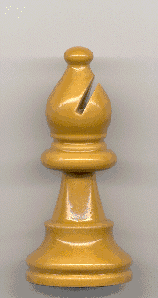
Staunton BS piece |
Shogi BS figurine |
Graphics of Staunton BS pieces |
|
01 See Major
Pieces. Ecclesiastical office,
pastor, presbyter, overseer, supervising minister. Barbara Harris was the first female appointed BS of a Massachusetts
Episcopal Church in 1989. The BS has
its origins in the Indian Elephant. In 798 Harun al-Raschid, the Caliph of
Baghdad, sent ambassadors and a gift of a white elephant to Charlemagne
(Carolus Magnus, Charles the Great).
As members of the clergy they enjoy certain civil rights such as the
right to conduct weddings, immunity from jury service and even the benefit of
certain charges on land (tithes).

They bear the title ‘Your Eminence’ and in recognition of this fact many kiss the jeweled ring that is
placed on their right hand as an indication of their office.
An official inscription, part of a royal decree exempting the priests of
Sneferu in Egypt from paying taxes was issued in the reign of KI Pepi-I of the
6th Dynasty. The Catholic
Church has 4,500+ BSs + VCs.
Prelate. Vaik: of a benefice,
office or position: to become or fall vacant.
Bishops. From the ‘Charlemagne’ pieces. Ivory.
Italy - end of the 11th Century. Paris Cabinet des médailles.
02 Illtyd: 6th
century Abbot of Llanwit Major and the most learned Briton of his day. His disciples demanded the old druidic right
to exemption from taxes.
03 Elder (Old
Testament): hereditary
head of a household - an office which depended on respect rather than statutory
authority. In Moses’ day, elders were chosen
by himself and he established government by aristocracy. Later they
formed the Sanhedrin. The Church of England has 50+
BSs.
04 New Testament: Elder,
Bishop, Presbyter (interchangeable terms).
In the 2nd century orders emerged.
Elders are mentioned in the book of Revelation. Bible: hippopotamus (Job).
05 Ganesha is the elephant-headed god of Hinduism and means ‘Lord of hosts’
(gana) and is revered as the remover of obstacles, the Lord of beginnings, and the Lord of learning who broke off
his tusk to write down the epic Mahabharata. Ganesha has
two wives ‘achievement’ and ‘intelligence’.
06 The word ‘copt’ comes from
the Greek word ‘Aigyptos’ and means Egypt.
The Coptic church has its own patriarch (BS/Pope).
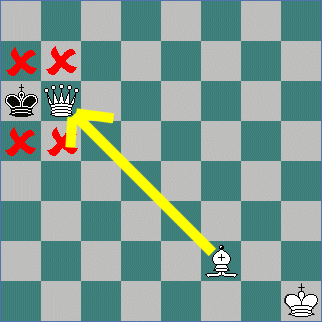
Below: this time A-BS on
cell/square F02 is defending A-QU on cell B06. This is ++CM. Don’t be nervous of bringing your QU near
to the enemy KI. Just make sure your
move is safe before you implement it on the chessboard.
07 On Level-1 each player starts the game with BS1 and BS2 (a dark and light BS). Because
a BS moves diagonally they stay on either the light (XL) or dark (XD) cells throughout the game. They are powerful attacking MPs when they are not blocked in, so you will find it
useful to bring them out early. They
are sometimes referred to as the ‘Bishop-pair’ (the others being the KT-pair and the RO-pair). The
two BSs working in tandem can dominate the whole chessboard and to your
advantage to keep them on the board until you are well into a game of
chess. Avoid trapping your BSs behind mps that have become fixed in their positions. A BS that works well with the mps (PAs, GUs etc) is called a ‘good-BS’. A BS that is trapped by PAs (lacking mobility) is called a ‘bad-BS’. Placed at the center of a clear board the BS commands 13 cells (D-Array).
Bishop
symbols/syntax
|
Symbol |
Description |
Reference |
|
bd-BS |
Bad Bishop |
42:01 |
|
rk-BSs |
Raking Bishops |
42:02 |
|
ds-BS |
Double Bishop Sacrifice |
42:03 |
|
pr-BS |
Protected Bishop |
42:04 |
|
01 |
|
|
02 |
|
|
03 |
|
|
04 |
|
|
05 |
|
|
06 |
[Event "bad bishops"][Site "-"][Date
"1956.??.??"][Round "?"] |
|
07 |
|
|
08 |
|
|
09 |
|
|
10 |
|
|
11 |
|
|
12 |
|
|
13 |
|
|
14 |
|
|
15 |
|
|
16 |
|
|
17 |
|
|
18 |
|
|
19 |
[Event "Two Bishops?"][Site ""][Date
"1873.??.??"][Round "?"] |
|
20 |
|
|
21 |
Bishop
Sacrifice
Place the MPs/mps on the board as follows:
Above: traditional figurine graphics
The XY notation is used on the left
(below). The Chesmayne acentric notation is indicated on the right (below).
01A BS2-D03*H07-PA1+CH - BS2-B02*D14-PA1+CH
01B KI-G08*H07-BS2 -
KI-D16*D14-BS2
02A KT2-F03/G05+CH -
KT2-B04/C09+CH
02B KI-H07/H06 - KI-D14/D13
03A QU1-D01/G04 -
QU1-D04/C08
03B RO1-F08/H08 - RO1-D17/D15
04A KT2-G05/E06-PA5+DC -
KT2-C09*B08-PA5+DC
04B KI-H06/H07 - KI-D13/D14
05A QU1-G04*G07-PA2++CM -
QU1-C08*C11-PA2++CM
05B ++WN for :A
++LS for :B
Set-up the board and play through the moves as shown above. Notice in the above example on move 04A
that A-BS1 gives +DC (discovered) to B-KI.
The BS may
move any number of cells diagonally.
Move and capture
|
|
|
|
|
The BS can move any number of cells in a diagonal direction and within cells of the same colour. A player starts a game with two Bishops, BS1 and BS2. |
|
BSs cannot move horizontally or vertically as shown with red marks. Players should have two Bishops: BS1 and BS2, one for the light cells (XL) and one for the dark cells (XD). |
|
|
|
|
|
The BS is blocked by a friendly piece, a RO. Here the BS cannot move to a cell occupied by the RO nor the cells that lie beyond: A08 and B07. |
|
The BS can capture the KT by removing him from the board and placing itself on the cell G02 but the BS cannot move to cell H01 (red mark). |
‘It was a blonde. A blonde to make a BS kick a hole in a
stained glass window’. (Farewell,
My Lovely, 1940).
Actress: Charlize Theron
08 In India a white elephant is a royal symbol (KI of the forest animals).
Ganesha is one of the most popular gods in India - the god of scribes
who is invoked at the beginning of books - god of journeys, enterprises, wedding negotiations,
practical wisdom, god of the sciences and skills, writing, and remover of
obstacles. In antiquity people
regarded the elephant as the wisest of all the animals because they live the
longest - their huge size indicating their noble birth.
09 Bishop - symbol: BS1 and
BS2.
10 MP which
moves along the diagonals. On Level-1 two of these MPs are used and are placed on $C01
and $F01.
11 The BSs have their origin in
the Persian ‘al-fil’
(elephant) which was allowed to jump over one cell. See Vaunt Courier, VC (the jumping BS).
|
Bishop. Scandinavian. Walrus tusk. Early 13th Century. The eye-holes would have contained precious stones. Copenhagen, National museum. |
12 Chaturanga: ‘Hasti’ moves diagonally, jumping over the adjacent
cell to the next cell.
13 Episcopus - Greek: Episcopos,
an overseer, religious or political.
14 Hatto: BS of
Mainz. Noted for his oppression of the
poor. During a famine he assembled the
poor in a barn and burnt them to death, saying: “They are like mice, only good
to devour the corn”. He retired to a
tower on the Rhine to escape the plague, but the mice followed him in their
thousands and devoured him.
15 ‘Do you know the BS of Norwich?’ The BS of Norwich was said to be such a
persistent talker that he sometimes forgot to pass the port.
Alligator
16 BSs are humorously/derisively called ‘magpies’ because they wear black and white vestments.
“Crocodiles in the sewers”. In
the East a bird of joy and good fortune. The BS is
known by different names in differing countries:
|
# |
Language |
Piece |
Game Name |
|
01 |
English Monogram |
Bishop - BS |
Chess – Chesmayne |
|
02 |
French |
Fou |
Les echecs |
|
03 |
German |
Laufer |
Schachspiel |
|
04 |
Italian |
Alfiere |
Gli scacchi |
|
05 |
Spanish |
Alfil |
Ajedrez |
|
06 |
Portuguese |
Bispo |
Xadrez |
|
07 |
Russian |
Slon |
IIIaxmatbl |
|
08 |
Arabic |
Fil |
Ash-shatranj |
|
09 |
Latin |
Episcopus |
Scaci |

Balloon Glow: Artist: Nicky Boehme. Pieces:
1500. Size: 24” x 33”.
17 This MP moves on the diagonal cells of the board. Symbol = BS. Historically the BS was the ‘elephant’ of Indian chess, but during the 15th century assumed
the present diagonal movement. There
is one BS for the XL cells (light) and one BS for the XD
cells (dark). It often happens during a game that one side will have a dark coloured BS and the
other side a light coloured BS. In this
case the BSs of opposite colour are unable to come into contact with each
other. It is also known as a ‘vector
MP’ or ‘line MP’. On an empty 8
x 8 board the BS controls
from 7 to 13 cells depending on the cell position. The BSs on $C01 and $C08 are sometimes referred to as QUs-BSs
and the other two on $F01 and $F08 as KIs-BSs (ISP). A BS captures diagonally, either forward or backwards and the range
extends on unobstructed cells to the extent of the diagonal line of cells on
which the BS travels. If you have many
PAs toward the conclusion of the game then try to capture your opponent’s BSs, because they
can impede the progress of your PAs more easily than KTs or ROs. If you have
many PAs at the end of a game and your opponent has a BS then try to move your
PAs to cells of a different colour to the diagonal that this BS operates
on. Having BS1 and BS2 at the end of
the game is preferable to having KT1 and KT2.
The BS is long-striding. The KT
is short-winded. The weakness of a BS
is in the defencelessness of the cells of opposite colour, its main strength in
its long-striding ability. BS1 and BS2
fortify each other and can rake two neighbouring diagonals (raking BSs). :rk-BSs. When
attacking the KIs position they are known as ‘Horwitz BSs’.

How
the BS moves

BS
fork

18 In the descriptive
notation they have the
symbols QB and KB. The two BSs together
are valued at more than double the value of one BS. A BS is often compared in valuation terms with the KT.
19 The Muslim ‘Fil’ with its two protuberances symbolized the elephant from which this MP
obtained its name. This was seen as a
BSs mitre in Europe and a recognition of the status of the church of the
period.
20 In Mongolia and Tibet the BS is called a ‘camel’.
|
Mate Using
Two Bishops |
||
|
|
There are
two types of working in
tandem |
|
21 In medieval
carnivals derived from the Roman Saturnalia the ‘BS of Fools’ was a burlesque figure who, after a brief,
dissipated reign, was actually or symbolically burned to death or otherwise sacrificed.
22 In Ireland
Fiana Fail is known as the BSs party. President Devalera spent ten days in the Irish College in Rome before
returning home to found Fianna Fail.

23 In the USA the BS
is the symbol of the Republician Party and members of this political party wear
elephant-motif ties. In medieval
England the power of the Church was recognized in naming this MP a BS. But our BS (English language) is known as
an elephant in Russia, a messenger in Germany, and a court jester in France!
24 Power of two
BSs: a BS is handicapped by being barred from half the cells of the board,
since BS1 moves only on cells of one colour.
This handicap disappears if BS2 is still on the board. With open diagonals a team of two BSs is particularly
strong. Because of this, an early
exchange of a BS for a KT is to be avoided unless something is clearly
gained.

25 In the 13th
century the BS was called ‘Alfyn’, a corruption of its Eastern name, ‘al Phil’, the Elephant.
The Alfyn is only allowed to move two cells diagonally and cannot capture a MP/mp that is nearer or further away. However, the Alfyn has the ability of jumping over any other MP/mp on its way to capture
(see, VC ‘Vaunt Courier’).
26 Viscount William Lamb
Melbourne: “Damn it all, another BS dead - I verily believe they die to vex
me”.
27 David (Dewi
Sant) Welsh: 6th century BS of South Wales.
28 The elephant is
used to personify both India and Africa.
29 Order of the Elephant: Danish
order of knighthood consisting of 30 knights.
30 White elephant:
an allusion to the story of a KI of Siam who used to make a gift of a white
elephant to courtiers he wished to ruin.
31 In the RC
church a novice must be 16, a deacon 22, and a BS 30. In the Church of England the ages are 23, 24 and 30.

Elephant, Amber Palace
BISHOP
ENDING
When the KIs and BS or KIs, BSs plus some mps are involved in the endgame.
BISHOPS
OF OPPOSITE COLOUR
When one side has a BS on the XL coloured cells and the other side has a BS on the XD coloured cells.
French: opposite colour
bishops - fous de couleurs opposes.
BISHOP
OF THE WRONG COLOUR
Used exclusively to describe a situation where a BS
cannot assist in the promotion of mp-01 or mp-08 (Level-1, 8 x 8 board), because the BS cannot attack the promoting
cell.
BISHOP’S
OPENING
The XY
notation is shown on the left. The acentric notation is indicated on the right.
01A PA5-E02/E04 - PA5-C04/A02
01B PA4-E07/E05 - PA4-C13/A03
02A BS2-F01/C04 - BS2-D06/B12
02B KT1-G08/F06 - KT1-D16/B07
03A PA4-D02/D03 - PA4-C03/B02
03B PA6-C07/C06 - PA6-C15/B10
Set-up the board and play through the moves
shown above.
BISHOP
PAIR

BS1 and BS2, usually compared to KT1 and KT2 or a BS and a KT. In some situations the BS-pair has a slight advantage over the
other two due to greater mobility.
The words below may
be found in this dictionary.
|
13:01 |
ABBA-ABBOT-ABBE-ABBESS |
|
13:02 |
|
|
13:03 |
|
|
13:04 |
|
|
13:05 |
|
|
13:06 |
|
|
13:07 |
|
|
13:08 |
|
|
13:09 |
|
|
13:10 |
|
|
13:11 |
|
|
13:12 |
|
|
13:13 |
BISHOP ENDING |
|
13:14 |
|
|
13:15 |
BISHOPS OF THE WRONG COLOUR
|
|
13:16 |
BODENS
CHECKMATE (++CM) |
|
13:17 |
|
|
13:18 |
|
|
13:19 |
|
|
13:20 |
|
|
13:21 |
|
|
13:22 |
|
|
13:23 |
|
|
13:24 |
|
|
13:25 |
|
|
13:26 |
|
|
13:27 |
|
|
13:28 |
|
|
13:29 |
|
|
13:30 |
|
|
13:31 |
|
|
13:32 |
|
|
13:33 |
|
|
13:34 |
|
|
13:35 |
|
|
13:36 |
|
|
13:37 |
|
|
13:38 |
|
|
13:39 |
|
|
13:40 |
|
|
13:41 |
|
|
13:42 |
VIDA MARCO GEROLAMO MARCUS
|
|
13:43 |
|
|
13:44 |
|
|
13:45 |
|
|
13:46 |
|
|
13:47 |
|
|
13:48 |
|
|
13:49 |
|
|
13:50 |
|
|
13:51 |
|
|
13:52 |
|
|
13:53 |
|
|
13:54 |
HORWITZ BISHOPS :ho-BSs
|
|
13:55 |
|
|
13:56 |
|
|
13:57 |
|
|
13:58 |
|
|
13:59 |
|
|
13:60 |
|
|
13:61 |
|
|
13:62 |
|
|
13:63 |
|
|
13:64 |

Ballooning: Artist: Gale Pitt.
Pieces: 500. Size:
18” x 24”
Chess (shatranj) was a legal issue after
Mohammad died in 642 A.D. In 655 his
son-in-law, Caliph Ali Ben Abu-Talib disapproved the game for his sect of
Muslims because of the graven images.
In 680 the 50th rule of canons was
interpreted as forbidding chess. But
the caliphs themselves played and had chess players in their circle of
influence. Legal scholars debated the
merits of chess. It was legal to play
chess if not played with items of chance (dice) and there were no betting or
gambling on chess.
It was still disapproved in 725 by Sulaiman ibn Yashar
but still popular among caliphs, especially when they moved their capitol to
Baghdad in 750 and took their top chess players with them.
The caliph al-Mahdi wrote a letter to Mecca religious
leaders to give up gambling with dice and chess in 780, but he died in 785 and
caliph al-Rashid came to power who was an avid chess player.
By 810 the top chess players in the world were known
and recognized and all had sponsors by powerful caliphs. In fact, the word Grandmaster was introduced by caliph
al-Ma’mun in 819 AD.
Chess was getting serious in India as well but tolerated. By 900 there was a problem of players
actually wagering fingers in their chess matches - you lose, you cut off a finger.
The Egyptian al-Hakim banned chess in Egypt in 1005
and ordered that all chess sets and pieces be burned in Egypt.
Chess had picked up in Europe and pretty soon many of
the clergy were spending more time playing chess than saving souls. In 1061 Cardinal Damiani of Ostin forbad the clergy from playing
chess. He died in 1072 and chess was
resumed in his domain.
By 1093 the Eastern Orthodox church condemned
chess. The Church stamped out chess in
Russia as a relic of heathenism.
In Europe some members of the clergy thought that
receiving a “check” in chess was similar to
committing a sin which one was able to redeem. A checkmate was similar to committing a sin that was perishable,
and thus deadly.
By 1100 chess was accepted as a regular feature of noble life in England. It was even a knightly accomplishment to
play chess in 1106 under Petro Alfonsi.
Chess was played by the upper classes and excluded women from playing
the game.
By 1115, the emperor of the Byzantine Empire was a chess addict. Despite that, it was still being banned in
the churches up to 1125. John Zonares,
a former captain of the Byzantine imperial guard, became a monk and issued a directive banning chess
as a kind of debauchery.
St. Bernard (1090-1153) forbade his knights Templars from playing
chess.
Chess became more popular during the crusades, but
Alexander Neckam, a British author, condemned chess as being frivilous.
By 1195, the Jews were seriously involved in playing
chess, but Rabbi Maimonides included chess among the
forbidden games for Jews.
In 1197 the Abbot of Persigny was warning folks not to play chess.
In 1208 the bishop of Paris, Odo Sully, banned chess in Paris to his
clergy.
It was also forbidden in Worcester, England in 1240 by the religious
leadership.
In 1254 St. Louis of France restricted chess to
laymen. Provinical councils were
forbidding chess in France (Beziers).
King Henry III (1207-1272) instructed the clergy to
leave chess alone “on pain of durance vile”.
In 1291 the Archbishop of Cantebury, John Peckman, was forbidding
chess. He threatened to put anyone on a
diet of bread and water if they played chess.
Priests were forbidden to play chess up to 1299. The Clementine Kormch wrote a series of
directions of priests. It included no
chess play.
Chess was forbidden in Germany in 1310 after the Council of Trier.
In 1322 the Jewish rabbi Kalonymnos Ben Kalonymous
condemned chess. By 1328 the Jewish
laws were interpreted by some Jewish leaders that chess could be played, but
not for money.
Chess was still forbidden in Germany up to 1329 after the Synod of
Wurzburg.
Charles V (1337-1380) of France prohibited chess.
In 1380 William of Wickham (1324-1404), founder of New
College, Oxford, and Winchester College, forbade chess. He was the Bishop of Winchester and the Chancellor of England twice.
Charles VI (1368-1422) of France continued to forbid chess. He later became unsane.
In 1405 John Huss (1369-0000?), Bohemian religious
reformer, sought repentance for loss of self-control at the chess table during
a game in Prague.
In 1416 the Jews of Forli, Italy relaxed a bit and
forbade all games of chance except
chess.
In 1420 Werner von Orseln, the Grand Master of the
Knights of the Teutonic Order, abandoned the prohibition of chess on the
grounds that chess was a proper amusement for a knight.
By 1476 chess was being played in France again under Charles the
Bold.
In 1495 the Inquisition saw victims of persecutions
stand in as figures in a game of living chess. The game
was played by two blind players. Each time the captured piece was taken, the person
representing that piece was put to death.
By 1500 chess was a recognized pastime for Jews on the Sabbath.
In 1549 the Protohierarch Sylvester wrote that those
who play chess shall go to hell and be accursed on earth. This was documented in his work Domostroi
(Household Goverment), a book of principles of family life. This was the first printed book in Moscow.
In 1550 Saint Teresa of Avila, a Spanish conventical
reformer, mentioned chess in her writings to illustrate ethics and chess. The Church authorities in Spain proclaimed
her patron of chess players.
In 1551 Czar Ivan IV (1530-1584), Ivan the Terrible, of Russia banned
chess.
The leading clerics compiled the Stoglav Collection
(council of the Hundred Chapters) in 1551, which prohibited chess in
Moscow. This same document prohibited
shaving as well as beards were said to imitate the visage of God and to distinguish Orthodox
males from women.
In 1575 a plague hit Cremona, Italy. Afterwards, all games were considered evil
and the cause of their troubles. All games but chess were banned.
Chess was still banned in Russia in the 17th
century. In 1649 Czar Alexei
(1629-1676) found some players playing chess and had them whipped and
imprisoned.
The Puritans were against chess and discouraged chess play.
Religious leaders who have played chess include Thomas
Becket (Archbishop of Cantebury), Charles
Borromeo (Bishop of Milan), Pope Gregory VI, Pope Innocent
III, Pope John Paul I, Pope John Paul II, Pope Leo X, Pope Leo XIII, Cardinal Richelieu, and Billy
Graham.
The Ayatollah Khomeini banned chess when he returned
to Iran. It was the only country in the
world that banned chess. He banned the
game because he thought it hurt the memory and could cause brain damage and that it contributed to a war-mongering
mentality. Prior to that, Iran, under
the Shah, was the only Arab country that organized chess and participated in
chess tournaments, including the 22nd chess Olympiad in Israel in 1976 (in
Haifa).
In 1996 chess and other clubs were banned from some
high schools in Salt Lake City, Utah.
Most of the school board is Mormon which condemns homosexuality. Rather than let gay high school students
form an organization, they banned all nonacademic clubs. School board members said federal law gave
them only two options: allow all extracurricular clubs or eliminate them
all. Some 30 clubs, including the
chess club, were banned for 1996-97.
Some present day Muslims still maintain that chess playing is a sin.
The origin of the name of the bishop is obscure. It was introduced in the 15th
century, taking the move of the courier and placed where the alfil used to be at the set up of
the chess pieces on a chessboard.
The appearance of the Muslim fil was formless but with two
protuberances said to symbolize the elephant from which the piece derives its name. Perhaps these suggested the bishop’s mitre,
hence bishop, the name used in English-speaking countries since the new game
gained acceptance.
The fil or al-fil (elephant) was also known as the sage or old man in Italy, a
Count in the oldest German references, and a fool in France.
The Spanish players knew that al-fil meant the
elephant, but this was not known in other European countries. The elephant was only known to most
Europeans through literature, and its use in war was hardly known at all.
The perversions of the world alfil led to alphicus
(leper), alpinus (the Alpine), africus (the African), Alpheus (a man’s name),
and alfiere (the standard-bearer). At a later
date in Southern Europe, the name became Delphinus, with its associations with the Dauphin (Dolphin) of France.
In other countries the bishop was known as the archer,
the runner (laufer), the counsel-keeper, the secretary, the soldier, the monk,
the spy (senex), the thief, and the administrator.
The original name aufin, once the ordinary name for
the Bishop in France and England, was replaced by the bishop.
The original move of the bishop (fil) was only three
squares diagonally. By 1500 it could
move to any open square diagonally.
From: Chess Kids Home Page

Below: the BS may move to any diagonal cell
Below:
the BS cannot move past the PA

Below:
A-BS can capture B-PA

Below:
the BS can capture any of the beta/black PAs
Below:
A-BS2 on F01 can capture B-RO2 on A06.
The
BS is worth 3 points. The RO is worth 5
points.
However,
the BS will be captured on the next move by B-KT2.
But
:A
will be up 2 points by making this capture!

Below:
A Discovered Attack.
B-PA5
has just moved from cell D07 to D05 attacking A-PA5 on E04.
But
notice that B-BS2 on cell C08 is attacking A-QU1 on cell F04.

Below:
A-BS2 should move from cell F01 to D03 in order to offer protection to A-PA5 on
cell E04. Is this a good move? No!
Why? Because B-KT2 on cell C06
would capture A-KT1 on cell D04 on the next move! Can you see a better move?

Below:
this is the following move when A-BS2 has moved from cell F01 to D03 to help
A-PA5 on cell E04. B-KT2 on cell C06
will now capture A-KT2 on cell D04.
A-BS2 also blocks A-QU1 from getting involved in the fight. Make sure you don’t make this kind of
mistake?