CHESMAYNE
shall
we dance!
american trilogy




|
|
KI |
|
|
|
KI figurines |
|||
|
|
|
||
|
Shogi
KI figurine |
Graphics of |
||
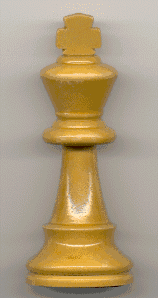


A KI is usually described as a male sovereign or monarch,
who holds by life tenure the chief authority over a country and people. The KI
regards his subjects as his children and admonishes his administrators to observe gentleness in dealing with them. The KI seems to radiate a
powerful authority and a strange intensity of feeling, characteristic of
statuary art. He sits on his throne
with his face radiating both authority and love - a haunting beauty - his majestic
presence inspiring awe and a sense of mystery.
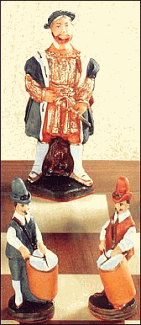
 Tudor Kings and
Queens chess
set. Among the established favourite
chess sets in our range, this set depicts the Tudor King, Henry
VIII, with his daughter, who became Elizabeth-I (not to be
confused with Elizabeth-II who is of a more recent vintage). This is an ideal
theme for a chess set because of all the cunning plans of the famous Archbishop Cranmer, who
is featured here in our Tudor set as the Bishop. King Henry VIII and Queen Elizabeth
I, together with Archbishop Cranmer and other characters of the Tudor period,
are used to form a most attractive and interesting chess set. This richly gilded and decorated set brings
alive the colours and fashion styles of the period. Printed Parchment Story Sheets are supplied
with each of these sets which give the history of the set and details of their
characters. Packaged in a fitted
presentation box. Crafted and imported from
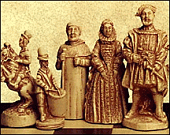
Tudor Kings and
Queens chess
set. Among the established favourite
chess sets in our range, this set depicts the Tudor King, Henry
VIII, with his daughter, who became Elizabeth-I (not to be
confused with Elizabeth-II who is of a more recent vintage). This is an ideal
theme for a chess set because of all the cunning plans of the famous Archbishop Cranmer, who
is featured here in our Tudor set as the Bishop. King Henry VIII and Queen Elizabeth
I, together with Archbishop Cranmer and other characters of the Tudor period,
are used to form a most attractive and interesting chess set. This richly gilded and decorated set brings
alive the colours and fashion styles of the period. Printed Parchment Story Sheets are supplied
with each of these sets which give the history of the set and details of their
characters. Packaged in a fitted
presentation box. Crafted and imported from
 ‘The KI never dies’
[Commentaries on the laws of
‘The KI never dies’
[Commentaries on the laws of
‘Punctuality
is the politeness of KIs’.
One of the
major figures (MPs) in the game of chess moving one cell in any
direction. One of the twelve chess draught pieces: K1 to K12. The KI is known under different names in differing
countries - see below. The KI in the 13th
century was allowed to make a leap, but only once in a game, and from this idea the castling move evolved. You must try to
keep your KI safe at all times as the aim of the game is to capture the enemy KI (++CM). At the beginning of a game it is best to move His Majesty to the side of the board by castling. If left in the center he is exposed to assault as the rest of your MPs/mps are developed. He is strongest in the endgame when there are few MPs and/or mps remaining and can help checkmate the opponent’s KI or even win MPs/mps.
Your KI can only move one cell per move and so has no attacking power during
the early part of the game.

“That the KI can
do no wrong, is a necessary and fundamental principle of the English
constitution”. [Commentaries on the laws
of
|
# |
Language |
Piece |
Game
Name |
|
01 |
English Monogram |
King KI |
Chess (old) Chesmayne (new) |
|
02 |
French |
Roi |
Les echecs |
|
03 |
German |
Koning |
Schachspiel |
|
04 |
Italian |
Re |
Gli scacchi |
|
05 |
Spanish |
Rey |
Ajedrez |
|
06 |
Portuguese |
Rei |
Xadrez |
|
07 |
Russian |
Korol |
IIIaxmatbl |
|
08 |
Arabic |
Shah |
Ash-shatranj |
|
09 |
Latin |
Scacus |
Scaci |
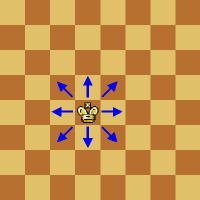
The KI may move only 1 cell vertically, horizontally or
diagonally.
|
|
|
|
|
|
|
|
|
8 |
|
|
|
|
|
|
|
|
|
7 |
|
|
|
|
● |
● |
● |
|
|
6 |
|
|
|
|
● |
KI |
● |
|
|
5 |
|
|
|
|
● |
● |
● |
|
|
4 |
|
|
|
|
|
|
|
|
|
3 |
|
PA1 |
PA2 |
PA3 |
PA4 |
PA5 |
PA6 |
PA7 |
PA8 |
2 |
|
RO1 |
KT1 |
BS1 |
QU1 |
KI |
BS2 |
KT2 |
RO2 |
1 |
|
A |
B |
C |
D |
E |
F |
G |
H |
|
|
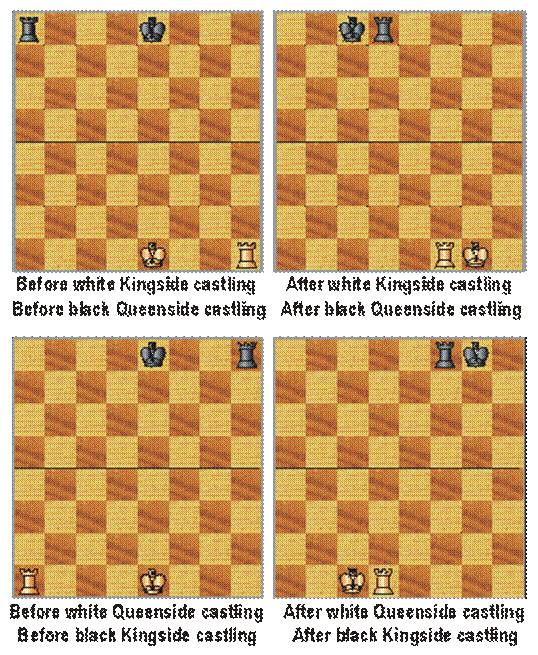
Kingside castling = 0-0. Queenside
castling = 0-0-0.
%Q and %K in the Chesmayne Notation.

|
|
|
|
|
|
|
|
|
KI |
KI |
KI & QU |
KI |
KI & QU |
KI |
KI, QU & PA |


The cell on which the KI resides (Level-1, $E01).
French: the sofa upon which the KI of France sat when holding formal
sessions of parliament. A game of
chess/session.

The KI plays two parts in the
game, while he is usually passive at first, later he frequently assumes an
active role. In fact, in the endgame the KI often has great influence as an active MP. In the middle of the board he controls
eight cells, all those in his immediate vicinity, and this is mainly useful in
protecting his own mps and attacking your opponent’s.
In the middle game it is above all the passive function of the KI that is predominant. The
danger of checkmate not only nearly always prevents him from taking part in the
struggle with the enemy MPs/mps but often even compels his own MPs/mps to give
him care and protection. Cases where the
KI supports the other MPs/mps in attack are extremely rare in the middle game.
It is much commoner in the middle game for the KIs qualities to be turned to
advantage in defense, in the protection of his own MPs and mps. If a MP attacks your KI try to interpose a
MP/mp that attacks the checking MP/mp if possible. Try to +CH the
opposing KI and oblige him to move, thus depriving your adversary’s KI of the
right to castle (this is considered good play). Sometimes you can give a sequence of
+CHs or even sacrifice a MP, to force the KI into the middle of B$D (rank-8), where the KI can be attacked by your other MPs/mps. In the
endgame phase your KI should be busily engaged and used to compensate for his
previous inactivity. The result of a
game may depend on your skill in managing the KI.
“Soon there will be only five KIs left - the KI of


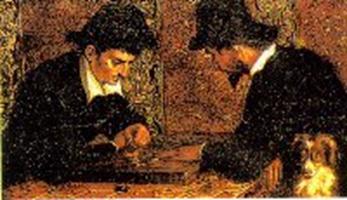
During the Middle Ages the
word ‘scacus’ was used for ‘KI’ but, during later periods ‘scacus’ was used for
any of the chess MPs/mps and its plural ‘scaci’ was used to denote the game of traditional chess
itself. The French retain the plural form ‘les echecs’, and the Italians ‘gli
scacchi’. In Ancient
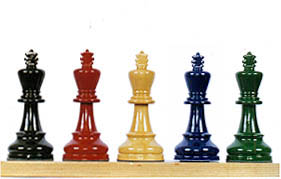
01A KI: Bible: the word derives from a root meaning to counsel or advise, ‘wise men’. God is called KI of Israel,
Psalms. Jesus is referred to as KI of the Kingdom in the book of Revelation. In civil matters the KI is the final court of
appeal and sometimes the head of religious orders. KI
David and KI Solomon
appointed and dismissed High Priests. Their officials were the
commander-in-chief, captain of the bodyguard, the KIs remembrancer or recorder
(Prime
Minister), scribe (Secetary of
State), the Chamberlain of the household and other minor officials. Magi in the plural: ‘magus’ means ‘wise men.’ KI or emperor and
often thought of as the embodiment of God. In alchemy,
the prima materia. Kingfisher: symbol of
marital happiness when seen flying in pairs.
KIs daughter or princess: symbol of the goal which the hero must reach. KIs son or prince:
the shining hero. KIs path: straight.
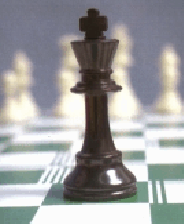
01B Melchizedek: KI of
02 Aztecs:
appointed a youth KI for a year, then tore out his heart.
03 Irish myth:
KIs and heroes are bound by contradictory ‘geasa’ (plural ‘geis’), or magical
prohibitions. To obey one ‘geis’ means
to disobey another, leading to fated
death.
04 Stag-King: also
known as the ‘horned god’, ‘green-man’, alias Cernunnos. The tradition of a man wearing stag-skins
being chased, killed and eaten (the hunter becoming the hunted) dates back to
at least 20,000 BC, as indicated by Paleolithic cave-painting at Alamira in
Spain and in the French Ariege.
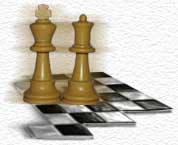
05 Henry-VII:
first Tudor KI of
06 Geoffrey of Monmouth:
Fabulist: euphemerised the Aeneas myth and claimed, in ‘The History of the KIs
of
07 China: Hsi Peh: ‘Chief of the West’ also known as ‘The Literary KI’.
08 Alain le Gros:
also known as the fisher KI.
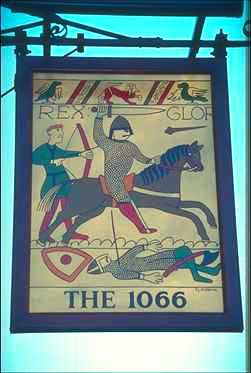
09 Seelie-Court: The Blessed
Court of the Fairies and the Aes Sidhe of
10 Wren: The KI of
the birds. Kingfisher:
also known as the Halcyon (Halcyon Days).
12
13
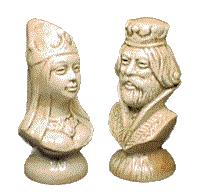
14 Die Fledermaus:
opera by Johan Strauss. Comedy, premiered in
15 I Samuel: 10:24 - ‘God save
the KI’.
16 ‘God save our
gracious KI! Long live our noble KI’
(attributed).
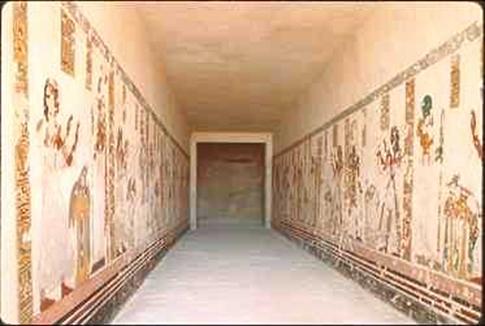
Tomb - Valley Of The KIs -
17 Erasmus: “Scitum
est inter caecos luscum regnare posse”.
“It is well known, that among the blind the one-eyed man
is KI”.
18 Plato: Every KI springs from
a race of slaves, and every slave has had KIs among his ancestors.
19 Shelley: My
name is Ozymandias, KI of KIs: Look on
my works, ye Mighty, and despair! - Ozymandias.
20 Wesley: Hark! The herald angels
sing, Glory to the new born KI.
21 KI Cole:
Legendary KI.
22 The Dolphin is
called the ‘KI
of Fishes’ and the ‘Arrow of the
Sea’.
23 KI of Misrule: mediaeval and Tudor times (director of horseplay and festivities) at Christmas. A KI of
Misrule was appointed at the royal court and at
24 A KI
Log: a KI who rules in peace
and quietness (never makes his power felt).
25 Pleionosis:
exaggeration of one’s own importance (Ozymandia syndrome). Universal to humankind and responsible for
titles such as KI of KIs, Grand Imperial Wizard, His Royal
Highness, the Right Honorable, Learned Gentlemen, Esquire etc.
26 Shakespeare, Hamlet: “I could be bounded in a nutshell and count myself a KI of
infinite space”.

27 Dey: titular
appellation of the commanding officer of the Janissaries of
28 Crocus: from
the saffron species the clothes of gods and KIs are made - being ‘gold-yellow’ -
symbol of light and majesty.

29 Jewels: symbol of earthly stars/starlets and showgirls etc. KIs and QUs crowns, the breastplate of high priests, fairy tale castles and Holy
Jerusalem are encrusted
with many types of jewels.
In old India, the king in
chess was called “k’sh”, and that he connects the word’s meaning to “
|
Mayan piece names |
||
|
King |
Ahau |
Yellow
Sun |
|
Queen |
Lamat |
Yellow
Star |
|
Warrior |
Cib |
Yellow
Warrior |
|
Counselor |
Ix |
White
Wizard |
|
Pawn |
Eb |
Yellow
Human |
|
Rook |
Ben |
Red
Skywalker |
|
Knight |
Akbal |
Blue
Night |
|
Bishop |
|
Yellow
Seed |
30 Film:
|
Year |
Film Name |
|
1927 |
The King of Kings (Warner) |
|
1927 |
King of the Herd |
|
1928 |
King Cowboy |
|
1930 |
King of Jazz |
|
1931 |
King of the Wild |
|
1931 |
The King of the Wild Horses |
|
1933 |
King Kong |
|
1936 |
King of the Damned |
|
1936 |
The King Steps Out |
|
1937 |
King Solomon's Mines |
|
1942 |
King Arthur was a gentleman |
|
1942 |
King of the Mounties |
|
1949 |
King of the Rocket Men |
|
1952 |
King of the |
|
1953 |
King Lear |
|
1954 |
King of the |
|
1954 |
King Richard and the Crusaders |
|
1955 |
King of the Carnival |
|
1956 |
The Ten Commandments. (Cecil B De Mille) Epic |
|
1956 |
The King and four Queens |
|
1956 |
The King and I |
|
1957 |
A King in |
|
1958 |
King Creole |
|
1959 |
Ben Hur |
|
1961 |
King of Kings |
|
1963 |
Kings of the Sun |
|
1964 |
King and country |
|
1964 |
The Gospel According to St Matthew. |
|
1965 |
The Greatest Story Ever Told |
|
1965 |
King Rat |
|
1966 |
King of Hearts/Le Roi de Coeur |
|
1970 |
King Lear II |
|
1972 |
The King of |
|
1972 |
King Boxer |
|
1973 |
Jesus Christ Superstar |
|
1976 |
Kings of the Road |
|
1976 |
King Kong II |
|
1977 |
Jesus of |
|
1980 |
The |
|
1988 |
The Last Temptation of Christ |
|
2004 |
The Passion Of The Christ |
You are not permitted to commit
suicide in chess: your KI must get out of +CH when your opponent has designs on
the KIs life. It is customary in a social setting to announce +CH, but if you do not do so, the +CH is still ‘on’ just the same, and your
opponent must extricate him/herself immediately. There are three possible ways of getting out
of +CH…….
01 Capturing the checking MP/mp.
02 Moving your KI to a cell
where he is no longer in +
03 Interposing a MP/mp between
the KI and the checking mp/MP. An interposition. N.B. The third scenario is not available when
a knight checks the KI.
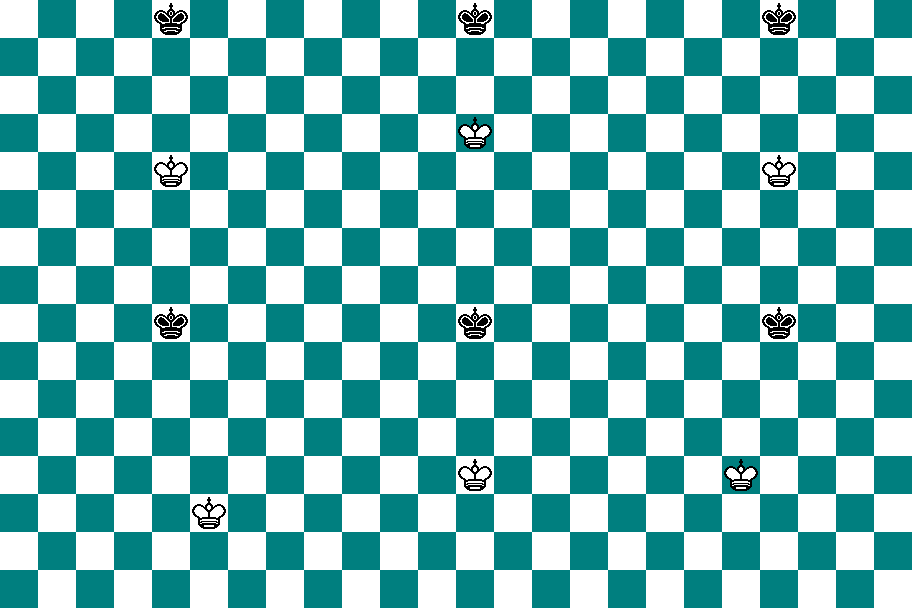
If none of the
above are available, it is ++CM, which the player announces (avoiding a
triumphant tone). This ends the
game. A KI may never move into +
KI and his court: the dominant ruling power in consciousness whether
individual or communal. The final
arbiter of values within. The ritual
renewal of the KI, either by replacement (originally with the sacrifice of the old KI) or regeneration, gave rise to much mythology, which provided the ritual words for the occasion. The symbolism around
the KI remains valid whether an actual KI is involved (representing his people)
or the myth survived outside its context and was presented as fairy-tales. The hero or sun
KI. The weak, feeble KI, often with a wicked vizer or prime
minister in
control. Often the KI is in need of
renewal. Like KIs, dominant attitudes
wear out, get dry and sterile. They
become too abstract, meaningless and ineffective, and lose their emotional
base. They fail to move. Whether mythical or real, the KI may combine
the qualities of Hero and Wise Old Man eg, KI Arthur,
Charlemagne, and perhaps Barbarossa. But
of course somebody who is not a KI can symbolize this
too, such as Sophocles, turning from GE into poet/playright. The Court:
whether in reality, myth, drama or fairy-tale.
Moses was rescued from the bulrushes by Pharaoh’s
daughter and brought up in the court.
Caerleon: traditional residence of KI Arthur ($E01, :L01), surrounded by hundreds of knights, 12 of which became the knights of
the Round
Table. The City of
The KIs of
KI/Lion: power. The carnival KI usually a criminal, given one
day’s rule. This is the tradition of
amnesty for criminals. Usurpers to the
royal throne or bed - the KIs mistresses especially if scheming. The wise BS or scheming
prelate. Chancellor/Dark Vizer. The fool. In Alchemy: the KI was the human personification of the work, the process of
transformation, in four main stages, which were the equivalent of transforming
base matter into gold. The lion is called the KI of the beasts. It symbolizes strength and power.
Film: The KI
and I: 1956 musical starring Yul Brynner, Deborah Kerr, Rita Moreno, Martin
Benson. The charismatic KI of
Alexander, KI of Macedonia:
he had two objectives, the wish to conquer the world and to amass all knowledge. He had the ability to
reorganize or redefine the parameters of a problem so that he could personally
solve it.
Shakespeare: ‘Time’s glory is to calm contending KIs, to unmask
falsehood, and bring truth to light’.
In ancient times KIs were
buried with their wives, slaves, horses and chariots.
KI James Bible: English version of the Bible
prepared under James-I and published in 1611.
Wen Wang (China)
1231-1135 BC, ‘The Literary KI’ who is traditionally regarded as being
responsible for the diagrams of the I-Ching or Book of Changes.
Lludd (Welsh): KI of
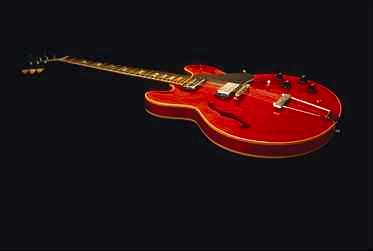
‘KI of Rock ‘n’ Roll’ 1935-1977: Elvis
Presley, born January
8th 1935 to
The
function of the KI
Your function as KI in a game
of chess is to snatch lightning from the sky and the scepter from the opposing KI.

The two KIs
have a special role in a contest, since the object as laid down in the rules (Level-1), is the pursuit and ++CM of the enemy KI.
If you capture all your opponents MPs/mps and the KI still remains at large then you have not won the game. The KI must at all
costs be protected from attack. Capture of the other MPs/mps may only be a means
to facilitate the final chase and submission of the opposing KI. The KI may
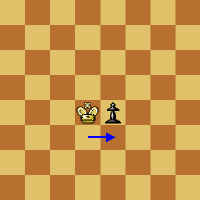
move one cell forward, backward, diagonally, or laterally (sideways). He may capture any one of your opponent’s
MPs/mps which stand on an adjoining cell to that which he occupies, provided
that the MP/mp has been left unprotected. The KI has the peculiar privilege of
being exempt from this indignity himself (capture, *). Your KI is not permitted
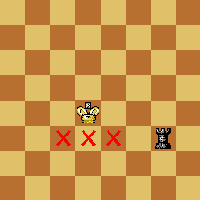
to move into +CH, that is, onto any cell which is guarded by a MP/mp of your
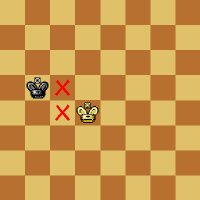
opponent. He may not be moved to a cell
adjacent to that on which the rival KI is stationed. If placed in B$A, B or C on a vacant board he may move to any of the
eight different cells surrounding him. If placed on the side of the board (B$D) he may move to any of five different cells. If placed in the corners of B$D, three cells
are at his command.
From: Chess Kids Home Page
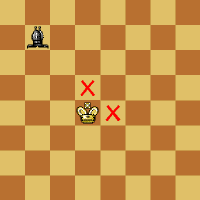
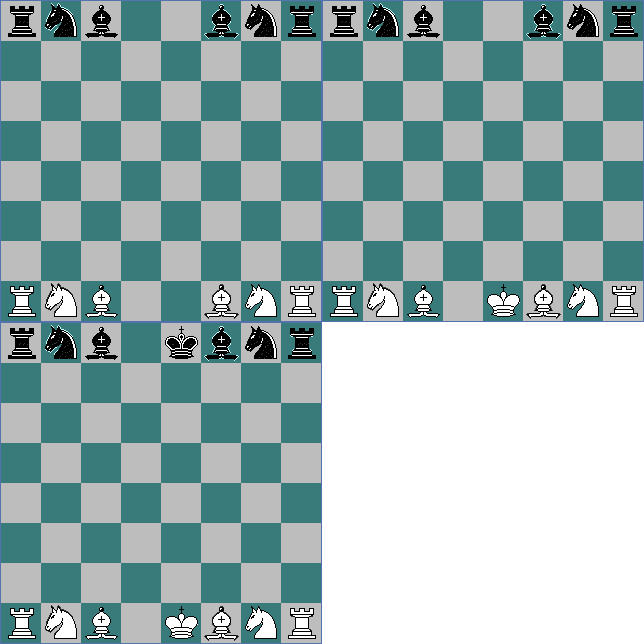
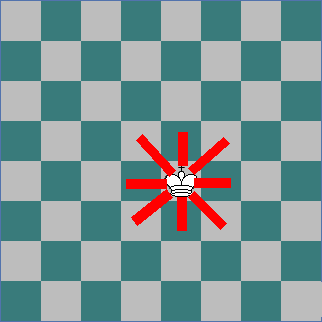
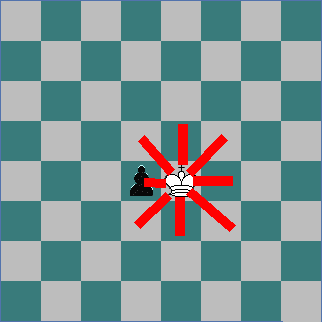
Below left: the KI can move to any of the 8 cells/squares
marked in red.
Below right: the KI can capture the PA on
cell/square D04.
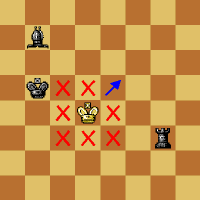
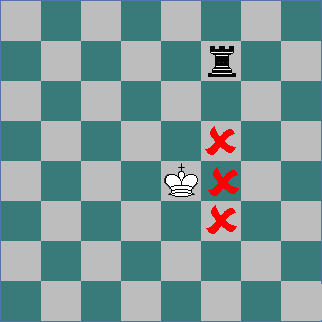
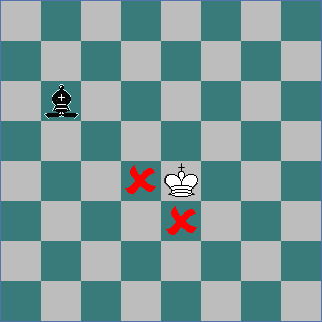
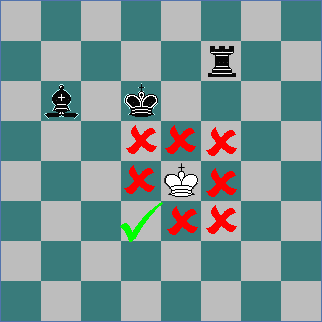
Below left: the KI cannot move to the cells/squares marked in red because they are attacked by the RO on cell F07. Below right: the BS on cell/square B06 attacks the line of cells along the diagonal.
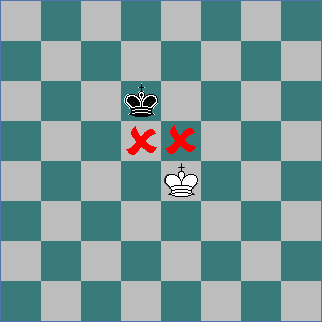
Below left: the KIs cannot must have one cell/square separating them. Below right: the only safe cell/square for the KI is D03.
King: just click
on a ‘keyword’ below…….
|
CHECKLESS CHESS |
|
|
DOUBLE
CHECK +DO |
|
|
HMB and HSH |
|
|
KINGSIDE CASTLING %K |
|
|
UBIQUITOUS |
ULTIMA RATIO REGUM |
|
UNCROWNED |
UTHER PENDRAGON |
|
VIVE |
|
|
WENCESLAUS |
|
|
BARE
KING ++BK |
|
|
|

CHESSKING.COM
Features the largest collection in the world
of exotic Chess Sets made from pure