
 2003
Special Olympics - Mohill is the host town for the team from
Democratic Republic of Congo (Congo Kinshasa)
2003
Special Olympics - Mohill is the host town for the team from
Democratic Republic of Congo (Congo Kinshasa)

 Mohill
was the host town for the team from Congo Kinshasa for the 2003 Special Olympics to
be held in Ireland - see
www.2003specialolympics.com for more information. There was bitter
disappointment in the town as the team were one of three that failed to travel
to Ireland due to visa difficulties. Other Leitrim towns
hosting teams are Drumshanbo (Mauritania), Manorhamilton (The Gambia) and
Carrick-on-Shannon (Bosnia).
Mohill
was the host town for the team from Congo Kinshasa for the 2003 Special Olympics to
be held in Ireland - see
www.2003specialolympics.com for more information. There was bitter
disappointment in the town as the team were one of three that failed to travel
to Ireland due to visa difficulties. Other Leitrim towns
hosting teams are Drumshanbo (Mauritania), Manorhamilton (The Gambia) and
Carrick-on-Shannon (Bosnia).
Each host town accommodateed and entertained a team and provided sporting facilities, allowing them to train before the Games. The teams arrived June 16th 2003 - they'll spend 4 days in Mohill before travelling to Dublin for the Games on June 20th. The Games opend in Croke Park on June 21st, 2003.
The Olympic torch arrived in Mohill on Sunday morning the 15th June. There was a great turn-out to welcome the torch and the law-enforcement team that brought the torch to Mohill. Among the many speeches, Art Ridge gave an inspirational speech, and referring to the large turn-out, noted that actions speak louder than words. Some photos of the day are here.
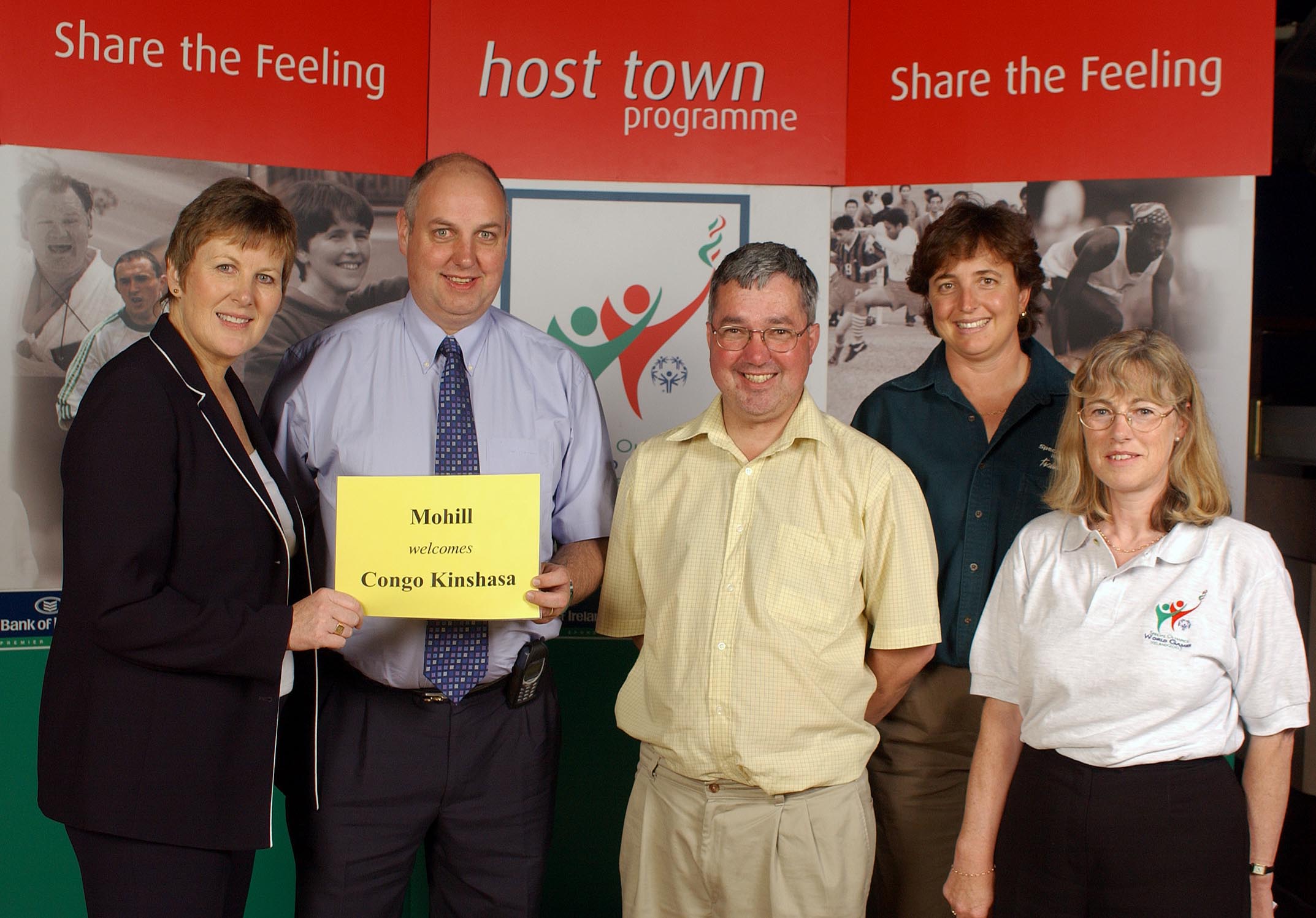 Pictured
at the Head of Delegation seminar which took place recently are, from left;
Geraldine Kane, Bank of Ireland, premier sponsor of the 2003 Special Olympics
World Summer Games,
Luke Earley, Chairman of the Mohill Host Town Committee,
Kieran O¹Beirne, Mohill Host Town Committee,
Mary Hoolihan and Heather Morris-Eyton, Head of Delegation. (click on the picture
at left for a higher
resolution picture) -
Photograph is © 2002 Fennell
Photography)
Pictured
at the Head of Delegation seminar which took place recently are, from left;
Geraldine Kane, Bank of Ireland, premier sponsor of the 2003 Special Olympics
World Summer Games,
Luke Earley, Chairman of the Mohill Host Town Committee,
Kieran O¹Beirne, Mohill Host Town Committee,
Mary Hoolihan and Heather Morris-Eyton, Head of Delegation. (click on the picture
at left for a higher
resolution picture) -
Photograph is © 2002 Fennell
Photography)
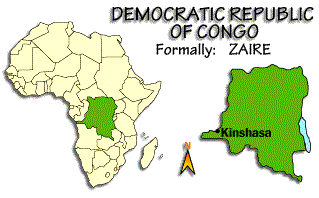
Where is Congo-Kinshasa? Well its now the Democratic Republic of Congo. It used to be called Zaire and before that the Belgian Congo. The population of the Congo is ~50,000,000, in land area, its about 1/4 the size of the USA, or 34 times the size of Ireland. The CIA has a synopsis of every country on the planet - the Congo here, Ireland here.
There is a link between South Leitrim and the Congo - In 1887, Thomas Heazle Parke (a surgeon) volunteered for the expedition being organised by Henry Morten Stanley to relieve Emin Pasha, (a German) governor of the Equatorial Province of Africa. The expedition travelled more than a thousand miles up the Congo river and then penetrated deep into the vast Congo forest, accomplishing its mission and reaching the eastern coast of Africa. In April of 1888 Parke was the first European in almost 1600 years, to set eyes upon the legendary ‘Mountains of the Moon’ (the Ruwenzori Range) in the Congo. The Greek geographer Ptolemy described them around 200AD - this was based on a discovery by Diogenes, who was blown off course while sailing to India, landed in Africa, and travelled inland for 25 days to the source of the Nile. Thomas Heazle Parke was born in Clogher House in Kilmore (Co. Roscommon) and is buried in Drumsna graveyard - he was 36 years old - 1857-1893. A statue of Parke is in front of the National History museum in Dublin beside Leinster House. More information and a picture of the statue are here.
Two other Irish links of note: Its where the Irish Army served on UN duty in the 1960s (29 soldiers died in action) - read this.
 Roger Casement (at left) served in the Belgian
Congo as a British Consul from 1901-1904. He produced a report in 1903 (here)
which led to international action being taken against King Leopold of Belgium,
the then ruler of the Congo - it was his personal colony, not a Belgian colony
at that time. For his courage, fortitude etc. shown in the Congo, Roger
Casement was awarded a knightood in 1911. Casement's report was included
in a book entitled "The
Crime of the Congo", written by Arthur Conan Doyle in 1909 ( author of
Sherlock Holmes books). Casement was hanged in London on August 3rd, 1916.
If interested in this area, I recommend the book "King
Leopold's Ghost", available from many bookshops.
Roger Casement (at left) served in the Belgian
Congo as a British Consul from 1901-1904. He produced a report in 1903 (here)
which led to international action being taken against King Leopold of Belgium,
the then ruler of the Congo - it was his personal colony, not a Belgian colony
at that time. For his courage, fortitude etc. shown in the Congo, Roger
Casement was awarded a knightood in 1911. Casement's report was included
in a book entitled "The
Crime of the Congo", written by Arthur Conan Doyle in 1909 ( author of
Sherlock Holmes books). Casement was hanged in London on August 3rd, 1916.
If interested in this area, I recommend the book "King
Leopold's Ghost", available from many bookshops.
Another interesting tidbit in the Congo's history is that none other than Che Guevara (who visited Dublin in 1964) led a group of Cuban guerrillas into eastern Congo in 1965. He was supporting rebels (followers of Patrice Lumumba, the first Prime Minister of the independent Republic of Congo, who was killed (by the CIA ?) in 1961.